
By Chris Bowers
On Saturday, May 16, Trump celebrated the defeat of incumbent Republican Sen. Bill Cassidy of Louisiana, who came in third in the Republican primary for U.S. Senate in that state, thus failing to advance to primary runoff. Cassidy had voted to convict Trump in his February 2021 impeachment trial, thus permanently earning him Trump’s ire.
On Tuesday, May 19, Trump won again, as Rep. Thomas Massie was defeated by a Trump-endorsed challenger in the Republican primary for the fourth congressional district of Kentucky. Massie frequently voted against Trump’s priorities on Capitol Hill, and also led the charge to release the Epstein files, thus earning him a permanent place on Donald Trump’s enemies list.
Now, you would think that after two big victories like that, Republicans on Capitol Hill would get the message that they should fall in line and do whatever Trump asks, right? However, instead exactly the opposite happened, as Trump faced the biggest series of rebellions from Republicans in Congress of his entire second term.
When it comes to the war in Iran, on Tuesday the Senate advanced a War Powers Resolution restricting further military action against that country without congressional approval. Notably, Sen. Cassidy provided the deciding vote, after voting with the majority of his party before he was defeated for renomination. Later in the week, House Republicans were forced to abandon their own vote on the War Powers Resolution, as it appeared the resolution would pass that chamber as well.
On Wednesday, Donald Trump’s $1 billion ballroom hit a major roadblock when Republican Senate leaders pulled funding for it from the reconciliation bill that is currently working its way through the Senate. They did this both for procedural reasons related to the peculiarities of reconciliation bills, and also because of significant opposition from Senate Democrats and Republicans alike (including, once again, Sen. Cassidy).
On Thursday, Senate Republicans went on their two-week, Memorial Day recess without passing the budget reconciliation bill they had been working on to fund immigration enforcement for the rest of Donald Trump’s term. Trump had given Republicans a deadline of June 1 to pass that bill, a deadline that now will not be met. This happened primarily due to massive Republican and Democratic opposition to the announcement of the $1.8 billion “anti-weaponization fund” that Trump had secured from his own Department of Justice as part of a settlement for a lawsuit he had filed over the unauthorized release of his tax returns. Senate Republicans are now apparently looking into ways to kill, or at least put guardrails on, the fund via the reconciliation bill.
So, what happened? Why were Trump’s big victories against troublesome Republican incumbents in Congress followed by the most significant Congressional revolt of his second term, instead of by Republicans just falling in line and doing whatever he asked? There are three main reasons for this:
1) Long gap between incumbents losing primaries and their replacements taking office.
There is an inherent weakness to party leaders like Donald Trump using primaries to replace sitting members of their own party who they do not like: the long gap between the primary elections and the start of a new Congress.
In the case of the recent Louisiana and Kentucky primaries, there is a nearly eight-month gap between the primaries and the start of the next Congress, when the incumbent who lost renomination will be replaced by someone more loyal to Trump.
Eight months is a really long time! It is one-third the length of a Congress (every Congress lasts for two years), and one-sixth of a presidential term. Defeating sitting members of Congress in primaries not only relieves all pressure you could ever exert on those members, but also gives them a lot of time to exact political payback by defeating your priorities. This process already appears to be underway, as Sen. Cassidy played an important role in the passage of the War Powers Resolution and in the defeat of Donald Trump’s beloved ballroom. Sen. Thom Tillis, who Trump effectively defeated for renomination all the way back in late June 2025, has played a key role in the current effort to defeat Trump’s new “anti-weaponization” fund.
So, using primaries to defeat troublesome incumbents in your own party is not exactly a magic wand to passing your priorities, as Trump found out this week. There are very real, tangible drawbacks.
2) Trump’s primary victories did not actually demonstrate total dominance over Republicans.
This may seem counter-intuitive at first, but a closer look at the results of nine primary elections held this month between Republican incumbents that Donald Trump didn’t like and Trump-endorsed primary challengers did not actually show Donald Trump has total dominance over Republican primary voters. Instead, those nine elections showed that a very significant minority of the Republican base is now actually outside of Donald Trump’s influence.
Here is what I mean. Looking at the nine results this month between what I will call “Rebel GOP Incumbents” and Trump-backed primary challengers in Indiana, Louisiana and Kentucky, the Trump-backed candidates won an average of 59% of the vote, while the Rebel GOP Incumbents won 41% of the vote:
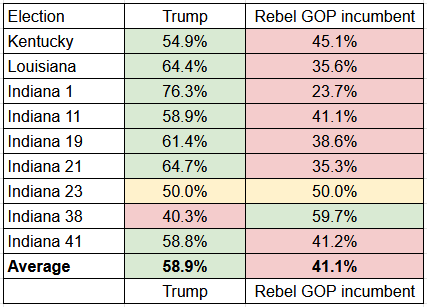
(Note: I made these calculations myself, so any errors are my own. In cases where there were more than a Trump-endorsed primary challenger and a Rebel GOP Incumbent in the Republican primary, such as Louisiana, I excluded the extra candidates from the calculations.)
On average, Trump was able to secure 18-point victories over the Rebel GOP Incumbents. This means that, on average, a little over two-fifths of Republican primary voters backed the rebels. In one case, a Rebel GOP Incumbent actually won, and in another the race remains too-close-to-call, pending a recount.
Certainly, this means that Trump has a lot of influence with the Republican base. However, it also means that Republicans who stand up to Trump are actually able to win a significant minority of support within their own party. I mean, 41% of anything is kind of a lot of that thing!
It is also likely that support for Rebel GOP Incumbents is growing. Every major tracker of Trump’s approval rating, Decision Desk HQ, The Economist, G. Elilot Morris, Nate Silver, the New York Times and Real Clear Politics has shown the same, gradual, downward trend during Trump’s second term. If that trend continues–and honestly, there is every reason to think that it will–then intra-party support for Rebel GOP Incumbents will grow as well.
3) The Republican majorities in Congress are quite narrow.
The final reason that Trump’s big primary victories did not help him on Capitol Hill is simply that the Republican majorities in Congress are pretty small, because the 2024 elections were actually quite close.
After the 2024 elections, the Republican majority in the Senate was 53-47 with Vice President J.D. Vance casting the tiebreaking vote, while in the House it was 220-215 (those latter numbers fluctuate quite a bit with retirements, health issues, and deaths of sitting members).
With margins like that, Trump and Republicans never had much room for error. However, in the Senate Trump has now cast several sitting members out of his good graces, including at least Sens. Cassidy, Collins, Cornyn, McConnell, Murkowski, Paul, and Tillis. In doing so, he has created–or perhaps emboldened–a swing group of Republicans that can join with Democrats to defeat any Trump-backed legislation or nomination they wish. And, as we saw this week, that is now exactly what we are seeing happen on a regular basis.
In summary, Trump’s victories against Rebellious GOP Incumbents may have scratched his itch for revenge, but they did not get him increased clout in Congress. In fact, Trump’s victories over Rebellious GOP Incumbents actually seems to have reduced his clout in Congress, and done so by quite a lot. It all reminds me of the old Oscar Wilde quote from An Ideal Husband:
When the gods wish to punish us, they answer our prayers.
Chris Bowers is a 20-year veteran of online, progressive grassroots news and political activism. For 14 years, Chris served as the director of the email and activism programs at Daily Kos, growing those programs from scratch into one of the largest grassroots news and activism operations in the history of the Internet. Before Daily Kos, Chris spent six years writing for the blogs MyDD and Open Left, as well as consulting for numerous political organizations and campaigns.
This article was sent on May 22, 2026 to The PeaceWorker and other groups by Chris Bowers.