
FYI: Another encouraging solar advancement. As new nuclear costs relentlessly rise, it will likely, sooner or later,
price itself out of the marketplace (in reality, it already has) — surviving only with endless taxpayer and ratepayer subsidies.
By Global Times
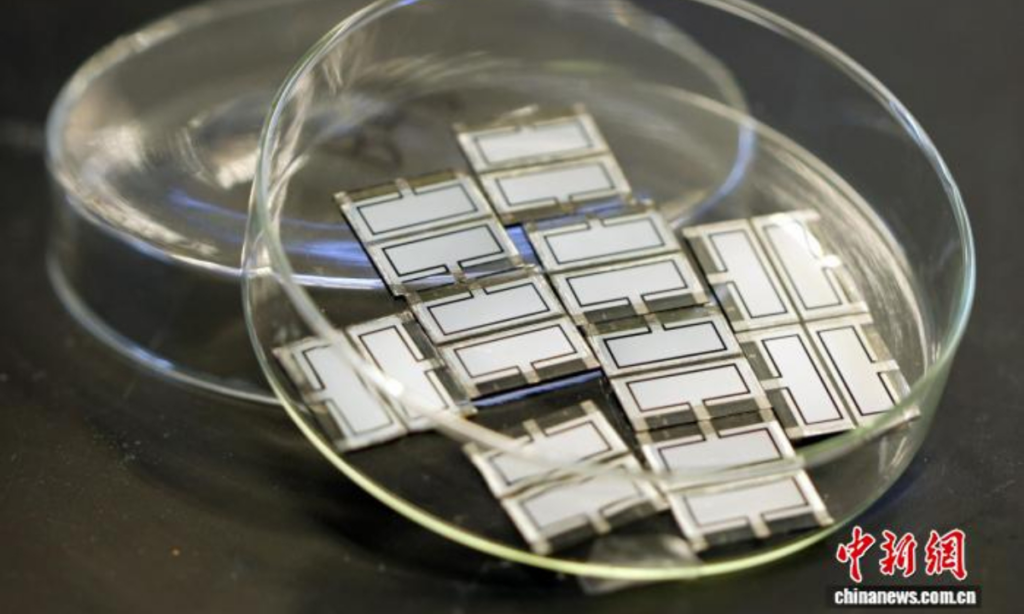
Photo: Screenshot from chinanews.com.cn
Chinese scientists have successfully developed a new type of solar cell that has achieved a steady-state power conversion efficiency of 28.04 percent, setting a new world record for this class of solar cells, chinanews.com reported on Monday.
By introducing a photo-convertible additive molecule, the research team led by Li Yongfang, an academician at the Institute of Chemistry, Chinese Academy of Sciences, and Meng Lei, a researcher from the institute, has successfully developed this high-performance perovskite-organic tandem solar cell. The study, published online in the international academic journal Nature on Monday, marks a critical step toward the practical application of this type of solar cell and could provide an important energy solution for future deep-space exploration.
Perovskite-organic tandem solar cells are designed to surpass the efficiency limits of single-junction solar cells by dividing the absorption of different wavelengths of sunlight between multiple layers.
It maintained 90 percent of its initial efficiency after 625 hours of continuous illumination, highlighting its excellent stability.
According to Li, this perovskite-organic tandem solar cell, with its lightweight, flexible design and high-specific-power advantages, could support energy transition and sustainable development, with applications ranging from buildings and wearable devices to satellites and other aerospace systems.
Further development and deployment of this technology could enable solar energy to power not only life and production on Earth but also future deep-space exploration missions.
The Global Times was launched in April 2009. From the day it was launched, the Global Times tentatively broke away from the journalistic tradition seen as normal in the Chinese media landscape, which avoids touching upon conflict and confrontation. It, however, distances itself from the other extreme, namely, designed provocation that is common in Western media’s China reportage. Given the circumstances in China, the Global Times takes great pains to present facts and views that could help the readers better understand China. [Learn more here.]
This article was published on July 14, 2026, at the Global Times.